
Fried Brothers in Blacktown
 1K+ Views
 100+ Likes
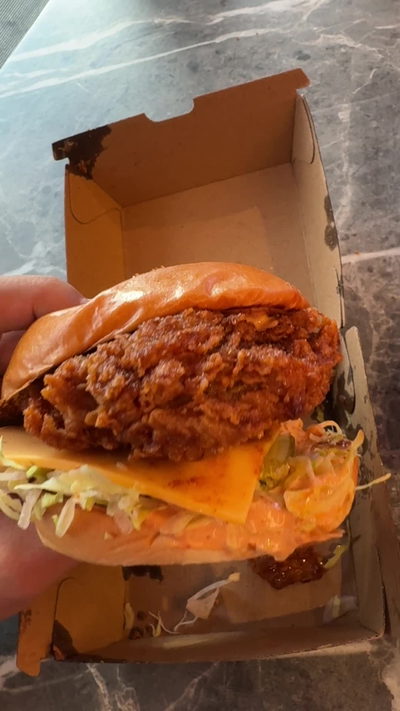
The video opens with a close-up shot of a chicken sandwich held in a person's hand, displayed against a plain gray marble-like surface with a cardboard box visible in the background. The sandwich features a crispy fried chicken breast, melted cheese, and fresh lettuce, all nestled between two halves of a bun. The camera remains static throughout the 3-second clip, focusing entirely on the sandwich. At the beginning, a voice says, 'İzlediğiniz için teşekkür ederim,' which translates to 'Thank you for watching.' The content is purely visual and audio-based, with no movement or additional context beyond the food item and its presentation.
 1K+ Views100+ Likes
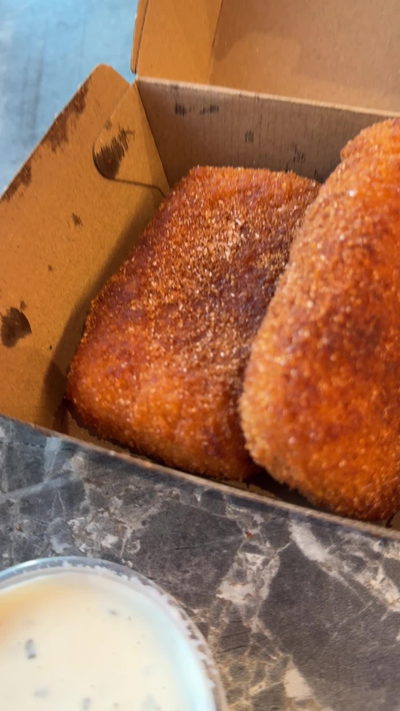
The video captures a close-up, static shot of a golden-brown, breaded appetizer—likely a mozzarella stick—being lifted from a cardboard container. The snack is freshly fried, with a crisp, textured crust and visible white seasoning, possibly salt or a spice blend. Two identical snacks remain in the box, and a small container of creamy, herb-speckled dipping sauce sits beside them on a marble-patterned surface. The scene is silent except for a brief 'Thank you' at the beginning (0s–5s), which appears to be a closing or acknowledgment rather than part of the visual narrative. The composition is clean and focused, emphasizing the food’s texture and visual appeal, with no discernible signage, venue context, or human presence. The setting appears to be a kitchen or food preparation area, but no broader environment is visible.
 1K+ Views100+ Likes
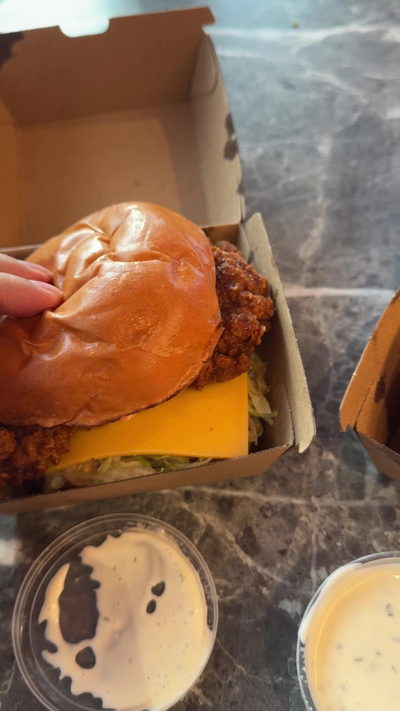
A static close-up shot of a chicken sandwich in a cardboard box, featuring a top bun, crispy chicken, cheese, and lettuce, accompanied by two small containers of sauce. The camera remains fixed throughout the 5-second clip, focusing solely on the food item with no movement, narration, or contextual cues. The only audio is a brief spoken question: 'You got it?' at the beginning, suggesting a moment of confirmation or anticipation, possibly related to a food delivery or order. The video lacks any signage, venue context, or human interaction, presenting the sandwich as a standalone visual object.
1K+ Views100+ LikesThe video opens with a close-up shot of a chicken sandwich held in a person's hand, displayed against a plain gray marble-like surface with a cardboard box visible in the background. The sandwich features a crispy fried chicken breast, melted cheese, and fresh lettuce, all nestled between two halves of a bun. The camera remains static throughout the 3-second clip, focusing entirely on the sandwich. At the beginning, a voice says, 'İzlediğiniz için teşekkür ederim,' which translates to 'Thank you for watching.' The content is purely visual and audio-based, with no movement or additional context beyond the food item and its presentation.
1K+ Views100+ LikesThe video captures a close-up, static shot of a golden-brown, breaded appetizer—likely a mozzarella stick—being lifted from a cardboard container. The snack is freshly fried, with a crisp, textured crust and visible white seasoning, possibly salt or a spice blend. Two identical snacks remain in the box, and a small container of creamy, herb-speckled dipping sauce sits beside them on a marble-patterned surface. The scene is silent except for a brief 'Thank you' at the beginning (0s–5s), which appears to be a closing or acknowledgment rather than part of the visual narrative. The composition is clean and focused, emphasizing the food’s texture and visual appeal, with no discernible signage, venue context, or human presence. The setting appears to be a kitchen or food preparation area, but no broader environment is visible.
1K+ Views100+ LikesA static close-up shot of a chicken sandwich in a cardboard box, featuring a top bun, crispy chicken, cheese, and lettuce, accompanied by two small containers of sauce. The camera remains fixed throughout the 5-second clip, focusing solely on the food item with no movement, narration, or contextual cues. The only audio is a brief spoken question: 'You got it?' at the beginning, suggesting a moment of confirmation or anticipation, possibly related to a food delivery or order. The video lacks any signage, venue context, or human interaction, presenting the sandwich as a standalone visual object.

